war in Iraq - war in Afghanistan - war in Palestine - war in ...

starts on march 20th 2010


Democracy and security in Iraq
The BRussells
Tribunal
exposes the recent legislative elections in Iraq
under foreign occupation for what they are:
US-scripted drama. The cumulative results of
draconian sanctions (1990-2003) and invasion and
occupation (2003-2010) destroyed the Iraqi state
and replaced it with corruption, terror and
falsification. Nonetheless, the political
machinations of the occupation will fail,
because it is a failed project.
March 04 2010
Abdul Ilah Albayaty
&
Hana Al Bayaty
By giving rein to its local feudal allies, the United States is pushing Iraq towards civil collapse and the potential of a regional war that could force its planned partition
|
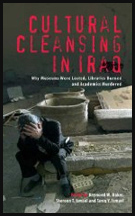
CULTURAL CLEANSING IN IRAQ |
|
You can order your copy of CULTURAL CLEANSING in IRAQ here, with a discount of 10% (the offer excludes the US, Canada, Australia) |
The staged dramatisation of
the Iraqi elections, by considering them a
decisive moment for the future of Iraq, is an
American propaganda plan against the Iraqi
resistance and the anti-occupation forces who
don’t participate in presenting candidates in
these elections. The Obama administration, in
committing itself — for financial and military
reasons — to its plan of withdrawal and the
handing back of Iraq to its people, was faced by
the reality that the Iraqi people in the days
and months before the electoral process began
developed a mood of disbelief in the political
process, as shown by their weak voter
registration.
The political process
produced a tragic situation for Iraqis:
generalised corruption in which ministers,
deputies and governmental institutions
participated without sanction; tens of thousands
of prisoners tortured, raped, sentenced without
fair trials; five million refugees without any
rights or protection, or even being recognised
as refugees by the government; the generalised
abuse of human rights; the absence of elementary
services like water purification, electricity,
or a sewage system; unemployment reaching up to
50 per cent of the population coupled with the
absence of decent means of income; no access to
health or education; the loss of rights as
workers or civil servants in the state; the
continuous fear of dying, being arrested,
kidnapped or displaced, among other fears.
Throughout the four years of this government and
parliament no law was written or decision taken
to assure the people of Iraq that the future of
the political process would be any different.
If the Obama administration
needs to save what it can of the legitimacy of
the political process before the eyes of the
American people by staging elections, its own
local allies saw them as a danger, as they would
lose power. The proof is the fact that none of
the forces allied to the US wanted to allow the
refugees — which they forcefully displaced — to
be allowed to participate in the elections.
Among other proofs is their decision to delay
the electoral law, regulating the elections,
until the last minute in order to dramatise the
elections. It is the US who pressured its allies
in the current parliament to allow the refugees
to participate in the vote while at the same
time ensuring this vote, by different means, is
unworkable.
During seven years of
occupation the US repeatedly used this pattern
of politics, consisting of pushing for or
remaining silent in front of attacks conducted
by its allies against the Iraqi resistance, its
supporters or alleged supporters, while at the
same time criticising by words — but not deeds —
these same attacks in order to win the hearts of
their victims, trying to make them believe that
the US will protect them against its allies. The
US is again using this pattern during these
elections. While the US has done nothing against
the relentless sequence of mass arrests,
deportations, executions, assassinations,
accusations, intimidations, falsifications, and
general illegal acts carried out by its allies,
it declares from time to time that the elections
should be transparent.
These elections are
falsified in advance. The falsification of
elections does not necessarily happen on the day
of the elections itself. When there are no
reliable records of voters, whether inside or
outside Iraq, when there is terror against
opponents and minorities, when there are no just
procedures and rules concerning political
entities, their financial mechanisms, their
electoral campaigns and regulating the equal
rights of rival candidates, when the government
can use the whole state apparatus and
institutions against its own rivals, it is
evident that the elections will be fake and will
not reflect the real will of the Iraqi people.
Many governments,
international institutions and associations
declared that they want that the elections be
free, fair and transparent. These good
intentions if not followed by acts on the ground
will be considered a silent endorsement of the
falsified results. We remember that UN Security
Council Resolution 1483 stipulated the
obligations of the occupying forces, but the UN
remained silent thereafter in front of the
occupation’s violations of these same
obligations, thereby giving the US the liberty
to do whatever it wants in Iraq as if it was
legal. In this context, it is evident that the
next parliament will again be a US product
composed of US allies with different faces, and
not real Iraqi representatives.
The Iraqi resistance and the
anti-occupation forces, the first political
force in Iraq, are aware of the use of this
repeated pattern of US policy. Therefore they
cannot and will not consider these elections as
legitimate or democratic. The antithesis between
the occupation and the resistance and
anti-occupation forces will be immediately
revived after the elections, as the primary
conflict in Iraqi politics. The resistance and
anti-occupation forces are opposed to the SOFA,
to the oil contracts, to the division of Iraq
and the destruction of this Arab and Muslim
identity, and the fascist religious regime that
Iran — ally of the US in Iraq — wants to
establish, and stand against all the results of
the occupation and its illegal political
process. They have the support of the Iraqi
people, which will not be represented and
reflected in these elections.
These forces know that the
tactics employed in the elections are used by
the occupation to divide them on the question of
whether or not they will participate in the
elections. For this reason, as is understood
from their literature and position, they will
not try to prevent their supporters from casting
their votes in support of this or that candidate
that they consider less awful than another, or
if he or she defends their immediate and local
preoccupations, as will happen in many
provinces, especially in Kirkuk, Mosul and
Baghdad. Thereby, they let the people realise by
their own experience that these elections will
change nothing in their lives. Assuring the
liberty to vote for their supporters will
prevent the occupation from using these
elections as a way to isolate the Iraqi
resistance from the Iraqi people. On the
contrary, the falsification of the elections and
the hypocritical pattern used by the US will
push some forces that believed in the political
process to quit it and join the anti-occupation
movement.
These tactics, which became
a repeated pattern used by the US, remind us of
those used — “the surge” — during the sectarian
killings of 2006-2007. These sectarian killings
were practiced under the eyes of, amid the
silence of, and some say with the active
participation of, the occupation. Only when the
killings produced their desired effects —
hundreds of thousands of deaths and millions of
refugees — did the US pretend to protect the
victims by imprisoning the regions they inhabit
by walls in order to control them. They punished
no one for the killings; neither did they do
anything to facilitate the return of the
refugees. The same is happening in the context
of these elections. While the US pretends it
wants transparent elections, the arrests, the
displacement, the generalised abuse of human
rights of individuals and communities, the
falsifications, the executions, the banning of
candidates, goes on unabated on the ground, with
no real acts to stop them.
This time the US is playing
with fire. Its tactics heighten the divisions
amongst local US allies, whose victims are the
Iraqi people. They potentially lead, in the
aftermath of the elections, not only to internal
civil strife but also to a regional war. The
political process has failed and no one wants to
repeat it for another four bloody years. The
essence of the US and its allies’ project during
seven terror-filled years is the partition of
Iraq. Its continuation in whatever form will
lead to a civil war.
Is the US using the elections and the
heightening of conflicts as an opportunity to
impose Biden’s project of partition as a fait
accompli? If the US, through the elections,
negotiates the future of Iraq and the extent of
this partition only with Iran and the Kurdish
leaders, its principal allies, other Iraqi
political forces will not bear that the Iraqi
people be victims of these machinations and will
reinforce their military, political and civil
resistance.
One of the dangers of
heightening existing conflicts during the
elections is that the US’s allies, the
pro-Iranian and the Kurdish leaders, did not and
will not accept transparent elections to realise
their project. They use and will use again force
— with or without US aid — to impose their plan
on the Iraqi people. Their plan is not only a
danger for Iraq and its people but also for
Iraq’s neighbouring countries. Any renewed civil
strife would involve a regional war. Is the US,
in spite of all its propaganda effort,
attempting to revive its failed project of the
New Middle East through a regional war? It is
time to realise that the only way to have peace,
stability and democracy in Iraq is an
unconditional withdrawal of all US forces, the
establishment of a transitional government
supported by the resistance, and to organise a
free, fair, transparent and democratic election
to hand Iraq back to its people. Without a
rupture with the political process and its
groups, Iraq will sink more and more into
tragedy.
 |
Abdul Ilah Albayaty is an Iraqi political analyst and
Hana Al Bayaty is coordinator of the Iraqi
International Initiative on refugees and both
are members of the Executive Committee of the BRussells
Tribunal . |
 |

|
||
|
The BRussells
Tribunal looks
forward to
volunteers for
the translation
of articles:
English-Dutch-French-Arabic-Spanish-German.
Please contact
us at
[email protected] |
||
|
Iraqi International Initiative on refugees click here |
| targeted killings of academics |
Souad Al Azzawi

Violations of Iraqi Children Rights
Under the American
Occupation
Dr. Souad Naji Al-Azzawi
is a former Vice-President of
Mamoun University of Scientific Affaires; former
professor of environmental engineering at
Baghdad Univ., recipient of the 2003
Nuclear-Free Future Award for her work on
environmental contamination after the Gulf War
in Iraq.
|
I
pride myself in
being a
scientist and a
researcher. I
built my
academic career
on theories and
numbers. As a
teacher, I teach
my students that
everything is
based in science
– everything has
a
reason.
That is why, I
am always
frustrated with
myself when I
find I am
overwhelmed with
feelings on
specific topics.
One such topic
is the
occupation of my
country, Iraq.
On this subject
I find that I
cannot always be
dispassionate. I
cannot be the
researcher and
observer and
discuss it
without feelings
or emotions as I
am sometimes
expected to do.
I find myself
doing research
on the damages
caused by the
war and
occupation, and
my head buzzes
with anger, my
eyes burn with
tears of
desperation at
the state of my
country.
I decided, I
would view it as
a scientist. I
would not attack
the subject with
emotion. I would
let the numbers
speak for
themselves. This
year I will sit
back and play
the part of the
analyst- the
researcher- on
the topic that
is closest to my
heart.
|
|||
|
For two decades,
Iraqi children,
along with all
other elements
of Iraqi
society, have
been subjected
to grave
violations of
human rights.
The American
occupation
forces, and the
occupation-assigned
Iraqi
government,
grossly failed
to fulfill their
most basic
duties towards
the children of
Iraq in
accordance with
the UN/CRC
Convention on
the Rights of
the Child,
Resolution 25/
Session 44,
November 1989.
The convention
was ratified by
194 United
Nations
countries,
except the USA
and Somalia.
Principals of
the CRC
emphasized the
need to protect
children’s
rights’ to life
and physical,
mental, moral,
and spiritual
development in a
safe
environment.
Numerous
violations of
Iraqi children’s
rights have
systematically
and continuously
been committed
under the
American
occupation of
Iraq.
We will show
that the
American
occupation
violated
children’s
rights on all
levels,
including health
care, education,
social security,
family unity and
the non
separation of
children from
their parents
through
detention,
imprisonment and
exile.
1.Iraqi Children under the Economic Sanctions (1990-2003)
During the
economic
sanctions
imposed on Iraq,
the country was
denied the right
to import
equipment,
medicine,
educational
items, health
care
requirements,
etc. The
economic
sanctions were
imposed by US/UK
administrations
and enforced by
UN resolution
2.Status of Iraqi Children under the Anglo-American Occupation of
Iraq
Thirteen years
of suffering and
the death of
more than half a
million children
under five as a
result of
economic
sanctions ended
with the
American
invasion of Iraq
in 2003. Iraqi
people, and
children have
had to face the
excessive use of
power, shock and
awe techniques,
raids, the
destruction of
infrastructure,
burning and
looting of the
civil services
and cultural
centers of Iraq,
damage to health
care centers and
hospitals, and
sectarian
killing staged
by occupation
intelligence.
Numerous
violations of
Iraqi children’s
rights have
continuously and
systematically
been committed
under the Anglo-
American
occupation of
Iraq.
■ Direct killing
during the
military
invasion
operations where
civilians were
targeted
directly.
Additional
casualties
amongst children
have resulted
from unexploded
ordinances along
military
engagement
routes.
■ The direct
killing and
abuse of
children during
American troop
raids on
civilian areas
like Fallujah,
Haditha,
Mahmodia,
Telafer, Anbar,
Mosul, and most
of the other
Iraqi
cities[17]. The
Massacre of the
children in
Haditha in 2005
is a good
example of
"collateral
damage" among
civilians.
■ Daily car
bombs
casualties,
explosion of
buildings and
other terrorist
attacks on
civilians.
■ Detention and
torture of Iraqi
children in
American and
Iraqi
governmental
prisons. While
in detention,
the children are
being
brutalized,
raped, and
tortured.
American guards
videotaped these
brutal crimes in
Abu Graib and
other prisons.
■ Poverty due to
economic
collapse and
corruption
caused acute
malnutrition
among Iraqi
children. As was
reported by
Oxfam in July
2007, up to
eight million
Iraqis required
immediate
emergency aid,
with nearly half
the population
living in
"absolute
poverty".
■ Starving whole
cities as
collective
punishment by
blocking the
delivery of
food, aid, and
sustenance
before raiding
them increased
the suffering of
the young
children and
added more
casualties among
them.
■ Microbial
pollution and
lack of
sanitation
including
drinking water
shortages for up
to 70% of the
population
caused the death
of "one in eight
Iraqi children"
before their
fifth birthday.
Death of young
children in Iraq
has been
attributed to
water borne
diseases such as
diarrhea,
cholera,
typhoid,
hepatitis, etc .
■ Contaminating
and exposing
other heavily
populated cities
to chemically
toxic and
radioactive
ammunitions.
Weapons like
cluster bombs,
Napalm, white
phosphorous, and
Depleted Uranium
all caused
drastic
increases of
cancer
incidences,
deformations in
children,
multiple
malignancies and
child leukemia.
Children in
areas like
Basrah, Baghdad,
Nasriya, Samawa,
Fallujah,
Dewania and
other cities
have been having
multifold
increases of
such diseases.
Over 24% of all
children born in
Fallujah in
October 2009 had
birth
defects.The
Minister of
Environment in
Iraq called upon
the
international
community to
help Iraqi
authorities in
facing the huge
increase of
cancer cases in
Iraq.
■ The
deterioration of
the health care
system and the
intentional
assassination of
medical doctors
have resulted in
an increased
number of
casualties
amongst
children. It has
been estimated
that the
mortality rate
amongst the
population of
Iraq reached
650,000 from
2003 to 2006.
Another survey
indicated that
the total number
of dead for the
period of
2003-2007 is
about one
million. Among
other cases, the
failures of the
health care
system were
specified as one
of the major
causes.
■ Damage to the
educational
system. By 2004,
it was estimated
that two out of
every three
Iraqi children
were dropping
out of school.
Statistics
released by the
Ministry of
Education in
October 2006
indicated that
only 30% of the
3.5 million
students were
actually
attending
schools. Prior
to the US
invasion, UNESCO
indicated that
school
attendance was
nearly 100%.
Assassination of
educators and
academics in
Iraq drove their
colleagues to
leave the
country. This
brain drain and
the intended
destruction of
schools and the
educational
system is part
of the well
planned cultural
cleansing of the
Iraqi society
and identity.
■ Total collapse
of Iraq's
economy, the
sectarian
violence,
American troop
raids on
civilians, the
killing of a
dear family
member have all
deprived the
children in Iraq
of an innocent,
carefree
childhood that
is the right of
any child. They
have to deal
with family
breakdowns,
poverty, and a
complete and
total lack of
security. Iraqi
children are
being forced to
assume income
generating roles
because their
families are
suffering from
hunger and
poverty. They
are leaving
schools and
having to deal
with adult
problems such as
unemployment,
manual labor,
etc. This
situation
exposes them to
hardship, and
many forms of
abuse. Exposure
to violence on a
daily basis has
affected their
psychological
development and
behavior as
well.
■ The drastic
increase in the
number of
orphans in Iraq.
The Ministry of
Labor and Social
Affairs
estimated the
number of Iraqi
orphans to be
around 4.5
million. Other
estimates put
them at around 5
million. About
500,000 of those
orphans live on
the streets
without any home
or family or
specialized
institutions to
take care of
them. Among
these orphans,
700 are in Iraqi
prisons and
another
■ The problems
of families who
were forced to
migrate and the
impact on their
children. Since
the invasion of
Iraq, there have
been about 2.2
million
internally
displaced people
who were forced
to migrate due
to sectarian
violence,
American
violence, etc.
Well over two
million other
Iraqis were
driven out of
Iraq. On
November 20,
2007 UNESCO
reports
indicated that
the number of
Iraqi children
taking refuge in
Syria alone was
around 300,000.
The problems of
children who
have been forced
to migrate
represent a real
humanitarian
crisis where a
large number of
families have no
shelter, no
finances, no
health care, no
education, and
no security of
any kind.
This case study
was conducted by
the author with
the help of the
Iraqi Women Will
body (IWW), an
Iraqi NGO
fighting for
Iraqi women’s
rights inside
and outside of
Iraq.
In October 2009,
around 300
copies of the
questionnaire
were distributed
to Iraqi
families within
the Yarmouk
refugee area of
Damascus, Syria.
The researchers
visited these
families to
ensure the
accuracy of the
answers and to
conduct personal
interviews. |
|||
|
You can read the case study and the conclusions on the website of The BRussells Tribunal here.  |


|
THE BRUSSELLS
TRIBUNAL IS
INDEPENDENT AND
WANTS TO REMAIN
INDEPENDENT. |

A message to the Americans
Nihal Fahad,
IT Engineer, Baghdad, Iraq
Your silence is louder than your bombsٍ
It
fills the void left by heartlessness
It
expands and falls thickly on indignant masses
And
smothers angst, outrage, and sorrow
Your silence is louder than your bombs-
It
dictates an unholy cowardice,
It
thrives on decay and lifelessness,
Ugly, sad, and sallow…
Your silence is more deadly than your guns
Insinuating your carelessness
Gray, cold, and hollow.
Your silence is thicker than the blood
That spills and colors holy ground
As
we watch- we listen- for the sound
Of
indignation that will never come
Your silence deafens, chills, and numbs
Louder than battle cries, and war drums…
It
resounds with the impotence of the dumb,
Death and destruction will surely follow…
So
call them home- call home your men-
Neither saviors, nor heroes, nor allies, nor
friends
The
mercenaries of a means to an end,
Let
us heal, let us live... leave tomorrow.



FIRST INTERNATIONAL AND UNITED MEETING OF THE
ANTI-OCCUPATION FIELD
International Conference of the Iraqi Political Resistance:
Gijón (Spain), June 18-20, 2010
Spanish Campaign against the Occupation and for
the Sovereignty of Iraq (CEOSI)

The Spanish Campaign against the Occupation and
for the Sovereignty of Iraq (CEOSI) will hold
its first international, public and united
meeting of the main currents in the Iraqi
resistance, those who to their project for the
full recovery of Iraq’s sovereignty add an
integrated, democratic and non-sectarian
reconstruction of its institutions.
This meeting, which aims to encourage the
convergence process of the anti-occupation field
and promote their
openness to the international community, will
take place in Gijón, Asturias, Spain, June
18-20, 2010, under the title:
International
Conference of the Iraqi Political Resistance.
This initiative will coincide with the beginning
of the eight year of the occupation of Iraq and
will be held while Spain holds the presidency of
the EU.
The forgotten news from Iraq does not mean that
the situation has improved, or that the end of
the occupation is near. The Iraqi people are at
a critical moment as they face their immediate
future. On March 7, 2010, new legislative
elections will be held, whose objective is to
conclude the consolidation process for internal
control in Iraq, with a view to a complete
withdrawal of the United States in 2011. As in
previous instances, the anti-occupation field
will not participate in elections it considers
illegal, though it will not interfere with
popular participation in those elections.
Iraq’s occupants have submitted the country to
the old colonial logic of social fragmentation.
The occupation, instead of bringing democratic
policies to Iraq, as its invaders claimed in
2003, has brought formal power to certain people
and sectarian organizations linked with the
occupiers themselves or with countries in the
region, without any legitimacy whatsoever. Their
game is not that of representing and defending
one or another of the Iraqi communities, but to
serve their foreign masters while enriching
themselves without impunity. The upcoming
elections in March 7 will only exacerbate this
failed dynamic and instead of enabling the
democratic expression of the Iraqi people, they
reflect the fight between US and Iran, for the
control of Iraq. For this reason, extremely
bitter conflicts are developing within the
collaborationist camp itself: according to
general opinion in the streets of Iraq, the
latest massive attacks in Baghdad and other
cities are the result (either through the direct
involvement or passivity of the security
services) of a ruthless struggle between
sectarian groups, who are resolving their
political differences at the cost of the lives
of hundreds of innocent Iraqis
The country’s subjection to occupation has cost
up to a million lives, according to the
estimates of prestigious international
institutions. According to the UN, during 2005
and 2006, up to a hundred Iraqis were killed
every day by death squads linked to the new
Iraqi authorities, and therefore, either
directly or indirectly, to the occupation
forces. Officially, 40,000 Iraqis are being held
by the US or the new Iraqi authorities.
Furthermore, the terror and repression have led
to the greatest exodus in recent history.
According to the UN, since the beginning of the
occupation, nearly five million Iraqis have
become internally displaced or forced to find
refuge outside the country: Iraq has more people
who have had to abandon their homes than any
other country in the world: 16% of its
population. For these Iraqis, return to their
homes is not feasible.
Inside the country, elections have not stirred
any hope of an improvement in the daily
situation which has not ceased to deteriorate
from day to day since 2003. Iraq, one of the
richest countries on the planet, formerly with a
large professional middle class, today
demonstrates paltry indicators in the areas of
education, health, electricity and potable water
supplies, as well as in respect to human and
social rights. Iraq is the fourth most corrupt
country in the world: in the strategic oil
sector that is gradually being privatized,
no-one knows where the revenues from oil sales
will end up. It is the political class imposed
by the occupiers that makes up a new oligarchy
which legitimizes the theft and dismantling of
public institutions through regressive
legislation, and which nullifies the concept of
citizenship and subjects the lives of Iraq’s
women and men to arbitrariness and helplessness.
Against this background, the project for the
recovery of Iraq’s sovereignty is inexorably
linked to the democratic and integrated
reconstruction of its institutions. The military
occupation must not give way to a puppet regime
or to the fracturing of the country into areas
influenced by neighboring governments that could
facilitate the unhindered plunder of its wealth
in the future. The Iraqi people want to fully
recover their sovereignty and the greatest
inheritance of their past, one that was embodied
in an integrated and dynamic society, despite
the adversity of its recent history. This is the
project that the Iraqi resistance embodies and
wishes to materialize, and that the meeting at
Gijón aims to further, in an atmosphere of trust
and freedom.
The democratic anti-occupation currents are
converging slowly, but inexorably. Since 2007
four Fronts have been created around which the
majority of the militant groups are coalescing.
The coordination among them has moved forward,
without materializing into full military
unification. More importantly, after the end of
the first phase of military confrontation with
the occupiers, the political and civilian
representatives of the
resistance continue their dialogue on a
program and common strategy, and on the need to
offer a united dialogue inside Iraq as much as
outside. It is an essential objective for Iraq’s
future, in order to achieve a democratic and
integrated solution to the crisis the occupation
has created.
This is the spirit of the meeting at Gijón, a
date to which the highest representatives of the
main anti-occupation Iraqi political and
civilian groups have already committed: the
Nationalist and Islamic Patriotic Front
(political organization of the Jihad and
Liberation Front), the Association of Muslim
Scholars (whose Secretary General, Sheikh Harez
Al-Dari, has been designated as political
representative by the military factions of the
Jihad and Change Front), the Political Council
of the Iraqi Resistance (political organization
of the Jihad and Reformation) and the Iraqi
National Foundation Congress (made up of more
than 20 civic associations and community
representatives), men as well as women who will
remember the essential role of this collective
in Iraq’s contemporary history:
Judeir
Al-Murshidi, Secretary General of the
Nationalist and Islamic Patriotic Front of Iraq;
Sheikh Bashar Mohamed Al-Faidi,
spokesperson and Executive Committee member of
the Association of Muslim Scholars; Sheikh
Ali al-Jubouri, Secretary General of the Political Council of the
Iraqi Resistance; Ayatollah
Yawad Al-Jalesi,
Secretary General of the Iraqi National
Foundation Congress; Sheikh
Ahmed Al-Ganim,
President of the Southern Tribal Council of
Iraq;
Arshad Zibari, Secretary General of the
Kurdish Justice Party;
Yusef Hamdan, member of the People’s Union (communist);
Asma
Al-Haidari, Human Rights activist;
Haifa
Zangana, writer; and
Isam Al-Chalabi,
former Iraqi Oil Minister (1987-1990)
and oil expert.
| The meeting will be organized with the collaboration of the Damascus based Independence Study Center, whose president, Khalid Al-Maani, will attend this meeting. The meeting will also be attended by personalities and representatives from the U.S., Europe and Arab world organizations, such as Hans von Sponeck and Ramsey Clark, a singular opportunity to restore or build ties with Iraqi organizations. In the context of Spain’s EU presidency, the visit of these distinguished political and social Iraqi leaders will be taken advantage of, to propose a direct dialogue with the Spanish authorities and Spanish and European political groups, among others. |

|
ON THE WEBSITE |
VIOLATIONS OF IRAQI CHILDREN Dr.Souad Al-Azzawi here |
STOP THE DEATH PENALTY IN IRAQ here |
KEEPING THE SCORES OF A BRUTAL OCCUPATION here |
METALS DETECTED IN PALESTINIAN CHILDREN'S HAIR here |
Please
do not reply,
but if you want
to send us a
message klick
here:
[email protected]
 |
||||